
San Francisco, Ca USA
Written by Michael Martin
There’s something deliciously sinister about Halloween in San Francisco. As October creeps toward its final days, the city takes on a darker personality. Costumes emerge from closets, candy cravings become impossible to resist, and whispers of haunted places and supernatural encounters seem to travel through the chilly evening air. For horror enthusiasts like myself, it’s the perfect time to revisit the nightmares that once kept us awake at night. So when I learned the San Francisco Symphony was bringing the 2002 horror classic The Ring to Davies Symphony Hall, accompanied by a live performance of Hans Zimmer’s haunting score, I knew I couldn’t miss this Halloween experience.
On Tuesday, October 20, 2026, at 7:30 p.m., Davies Symphony Hall transformed into an unlikely house of horrors as film lovers, music enthusiasts, and devoted horror fans gathered for a special screening of director Gore Verbinski’s supernatural thriller. The atmosphere was already buzzing when I arrived, with a lively crowd filling the hallways and plenty of guests dressed in black, clearly embracing the evening’s darker theme. Naturally, I came prepared in my signature all-black attire, but a night this stylishly sinister called for some extra fashion firepower. I invited my dear friend, legendary glove designer Tristan, also known as Joshua David of Majesty Black, to join me. After all, a movie about a mysterious girl with long black hair crawling out of a television practically demands dramatic leather fashion. Our signature Majesty Black gloves fit the mood perfectly, adding a little gothic glamour to an already unforgettable evening.
My fascination with The Ring goes back much further than its American theatrical debut. The nightmare began in Japan with Ringu, the groundbreaking 1998 supernatural psychological horror film that sent shock waves through Japanese audiences before inspiring Hollywood’s 2002 adaptation. Based on Koji Suzuki’s 1991 novel, the original film helped introduce international audiences to a terrifying new dimension of Japanese horror. A few years after its release, I was living in Tokyo, immersed in Japanese culture and hearing firsthand accounts of the film’s frightening impact.
Stories circulated about audiences being absolutely terrified, and the more I heard, the more determined I became to experience it myself. Japanese horror got under your skin in a different way. Rather than relying entirely on blood, violence, or sudden scares, it understood the unsettling power of silence, suggestion, atmosphere, and the things we fear but cannot explain. That psychological tension made Ringu unforgettable, and it was precisely what I hoped to experience again at Davies Symphony Hall.
For those unfamiliar with the story, The Ring centers on a mysterious, cursed VHS videotape that contains a disturbing collection of images, cryptic symbols, static, and nightmarish visions. Anyone who watches the tape receives a chilling telephone call warning that they have only seven days left to live. Naomi Watts delivers a compelling performance as investigative journalist Rachel Keller, whose investigation into the tape’s origins draws her into an increasingly disturbing supernatural mystery. At the center of the terror is Samara Morgan, portrayed by Daveigh Chase, a ghostly young girl with long black hair, a pale complexion, and a haunting white dress. Her appearance draws on imagery deeply rooted in Japanese ghost folklore, where long, disheveled black hair and white burial garments have long symbolized restless spirits. Samara became one of modern horror’s most recognizable figures, joining the ranks of legendary screen nightmares such as Jason Voorhees, Michael Myers, and Freddy Krueger, but with an entirely different kind of terror. She didn’t need a machete or a knife. A television screen was frightening enough.
Although Verbinski’s American adaptation departed significantly from the original Japanese film and Suzuki’s novel, it created its own haunting visual identity. The film’s atmospheric green-tinted cinematography, rain-soaked Pacific Northwest landscapes, unsettling imagery, and lingering sense of dread gave the story an almost hypnotic quality. Watching it again more than two decades later reminded me how effectively the film turns ordinary objects into sources of terror. A television, a telephone, an old videotape, and even the simple sound of static suddenly become things you never want to encounter alone after midnight. But this particular screening offered something the original theatrical experience could not: the chilling power of a live symphony orchestra breathing new life into every frightening moment.
That musical dimension belonged to legendary composer Hans Zimmer, whose extraordinary career includes scores for Gladiator, Pirates of the Caribbean, The Dark Knight trilogy, Blade Runner 2049, and Dune. Known for creating enormous cinematic soundscapes, Zimmer took a strikingly different approach with The Ring, using a darker, more restrained musical language to amplify the film’s psychological unease. Rather than overwhelm the audience with grand orchestral flourishes, the score builds tension through unsettling textures, lingering notes, and ominous musical shadows. It’s a reminder that sometimes the most frightening sound is the one that barely seems to be there.
Making his San Francisco Symphony debut, guest conductor Jason Seber took the podium to guide the orchestra through Zimmer’s eerie musical world. Before the film began, Seber addressed the audience, explaining the score’s minimalist nature and the unusual musical experience awaiting us. Then, as his introduction neared its end, his cellphone suddenly rang. He answered the call and delivered the film’s infamous warning: “Seven days!” The timing was perfect, drawing the audience into the spirit of the evening before the first terrifying images appeared on screen. It was a playful touch that reminded everyone this would be no ordinary night at the symphony.
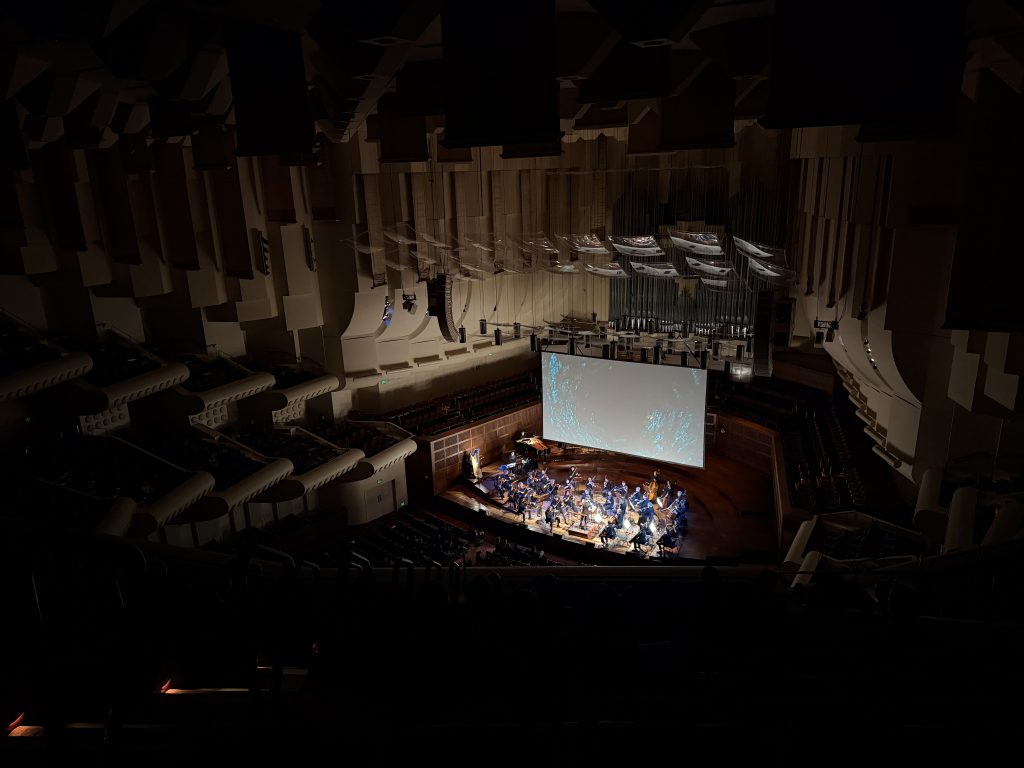
As the lights dimmed and the movie began, Davies Symphony Hall seemed to come alive. The orchestra, performing beneath the enormous screen, created an atmosphere that was both mesmerizing and deeply unsettling. The musicians followed the film with remarkable precision, allowing Zimmer’s haunting score to emerge from the shadows and surround the audience. At times, the music was so subtle that it felt like a presence lurking somewhere in the darkness. At other times, swelling strings and ominous tones heightened the suspense until the entire hall seemed to hold its breath. I’ve attended many San Francisco Symphony performances over the years, but this was unlike anything I had experienced before. The combination of a classic horror film and live orchestral music created an entirely new level of psychological intensity.
The audience became part of the experience, too. A wonderful tension emerged between the concert hall’s stillness and the anticipation of the next frightening moment. Every unsettling image seemed magnified by the live score, and the familiar scenes felt fresh again, even for those of us who knew exactly what was coming. That is the beauty of presenting a film like The Ring with a live orchestra. You aren’t simply watching a movie you’ve seen before. You’re experiencing its emotional architecture in real time, with every musical detail adding another layer of suspense.
Fortunately, the evening also offered a chance to escape the nightmare during intermission, though I wasn’t entirely convinced the hall wasn’t haunted by then. Tristan and I ventured into the lobby, where we discovered a merchandise table featuring The Ring T-shirts, tote bags, and keychains, perfect souvenirs for anyone brave enough to take a little piece of the curse home. The bars were busy with concertgoers looking for refreshments, but experience has taught me a valuable Davies Symphony Hall survival trick: when the main bar has a long line, head toward the one in the back. Sure enough, we found a much shorter wait and ordered the evening’s spooky purple Halloween cocktail. With its mysterious color and festive presentation, it was a fitting addition to the night. One might even say it was to die for.
Before long, it was time to return to our seats and descend into the nightmare once again. As the film moved toward its terrifying conclusion, the Symphony’s ominous strings and unsettling musical textures tightened their grip on the audience. Then came the moment everyone had been waiting for, or perhaps secretly dreading. Samara slowly emerged from the television screen, her long black hair concealing her face as she crawled toward her victim. Even knowing the scene was coming, watching it unfold on the enormous screen while the orchestra intensified the atmosphere was genuinely spine-tingling. It remains one of modern horror cinema’s most unforgettable images, and the live musical accompaniment made it feel even more disturbing. Suddenly, the distance between the audience and the nightmare seemed a little too small for comfort.
What impressed me most was how successfully the San Francisco Symphony transformed a familiar horror film into something theatrical, immersive, and unexpectedly intimate. Under Seber’s direction, Zimmer’s restrained score became an essential character in the story, reminding us that great horror is often as much about what we hear as what we see. The performance also showed the Symphony’s versatility and its ability to reach beyond traditional concert programming, inviting film fans and curious newcomers into the extraordinary world of live orchestral music. Something wonderfully surreal happened when we sat in one of San Francisco’s most elegant cultural venues, surrounded by beautifully dressed concertgoers, as a vengeful spirit crawled out of a television screen above the musicians.

As we stepped back into the San Francisco night, I couldn’t help but smile at the strange mix of fashion, nostalgia, Halloween mischief, and genuine cinematic terror we had just experienced. What began as a Tuesday night outing became a haunting celebration of Japanese horror’s influence on American cinema, Hans Zimmer’s musical imagination, and the San Francisco Symphony’s remarkable artistry. For a lifelong horror fan, it was the perfect way to welcome Halloween week, complete with dark leather gloves, a spooky purple cocktail, and enough supernatural suspense to make me reconsider my old VHS collection, especially the tapes I brought back from Japan.
One thing is certain: I won’t be watching any mysterious videotapes anytime soon, and if my telephone rings in the middle of the night, I might just let it go to voicemail. Until our next musical adventure, I can’t wait to see what the San Francisco Symphony has in store. But for now, if you hear someone whisper “Seven days,” you might want to think twice before answering.
For more information about upcoming performances and special events, visit www.sfsymphony.org.
