

San Francisco. Ca USA
Written By Luna Sky
On Friday, November 20, 2026, San Francisco’s Mission Bay waterfront belonged entirely to Carl Cox. Headlining Season 2 of Goldenvoice’s Club Darc series inside Shed A at Pier 48, the British dance music titan delivered a masterclass in electronic music command that reminded everyone in the building why, more than four decades into his career, nobody works a room quite like him. From the moment doors opened at 8:00 PM across from Oracle Park, the 85,000-square-foot historic warehouse felt less like a standard concert stop and more like an old-school underground pilgrimage given big-room Bay Area muscle. Forget the conventional nightclub experience. This was a night for the dance music faithful, a celebration of rave culture, and a chance to surrender to the infectious energy of one of the greatest DJs ever to step behind the decks.
Shed A at Pier 48 has quickly carved out its own gritty lane in San Francisco nightlife. Rather than relying on polished festival spectacle, Club Darc leans into raw industrial scale: soaring exposed beams, massive twin disco balls throwing shards of light across the concrete expanse, purple ambient washes, and a phone-free dance floor policy, complete with camera stickers handed out at entry, that keeps eyes off screens and locked onto the music. In an era when so many dance floors have become seas of glowing smartphones, there’s something wonderfully liberating about being encouraged to put the technology away and actually live in the moment.

Remember when going out meant losing yourself in the music rather than documenting every second? Club Darc certainly does. Between the sprawling main floor, lounge pockets, outdoor food trucks, and easy waterfront access steps from Muni and Caltrain, the venue captures the stripped-back spirit of classic European warehouse raves while carrying the unmistakable energy of a Friday night by the bay. It’s raw, unapologetic, and refreshingly focused on what matters most: the music, the people, and the dance floor.
Of course, when Carl Cox is on the bill, expectations are understandably through the roof. Affectionately known throughout the global dance music community as the King of Techno, Cox has been instrumental in shaping electronic music culture, from the pioneering days of Britain’s acid house and underground rave movement to his legendary residency at Space Ibiza and appearances on some of the world’s biggest festival stages. His pioneering three-deck mixing helped establish his reputation as a technical wizard, but his influence extends far beyond his abilities behind the decks.
Through his record labels, radio shows, global performances, and unwavering passion for discovering and championing new music, Cox has helped introduce generations of dancers to the extraordinary possibilities of electronic sound. What makes his longevity even more impressive is that he’s never lost that infectious enthusiasm. Despite decades of global success, he still looks like he’s having as much fun as the people on the dance

floor. That unmistakable smile, booming personality, and genuine love for the culture are as much a part of the Carl Cox experience as the thunderous basslines. Oh yes, oh yes!
Before Cox ever touched the decks, the supporting bill laid down a smart, escalating groove that pulled the room together piece by piece. Melbourne selector William Kiss set the early pace as the first wave of dancers filtered in off the crisp November waterfront air, threading tight, percussive tech-house rhythms through the cavernous hall and giving the floor an immediate pulse. Opening a room this size requires a particular kind of musical intelligence: knowing when to build momentum without prematurely unleashing the night’s peak energy. Kiss understood the assignment, laying a hypnotic foundation and giving the steadily growing crowd plenty of reasons to move.
By the time Detroit-bred favorite Seth Troxler stepped into the booth, the room was already humming. A formidable headliner in his own right and one of electronic music’s most charismatic and eclectic personalities, Troxler brought his signature blend of underground sensibility and musical unpredictability to the waterfront. He played to his strengths as a dynamic selector, teasing deeper, hypnotic textures, flipping moods with effortless swagger, and ratcheting up the tension until the entire warehouse felt coiled and ready to blow. Troxler’s ability to move between house and techno without making those boundaries feel particularly important is part of what makes him such a compelling artist. His set was a beautifully calculated exercise in anticipation, keeping dancers guessing while steadily turning up the heat.
The crowd itself was a living snapshot of San Francisco’s multigenerational dance DNA, and, of course, the fashion was every bit as eclectic as the music. From neon-lit club kids and underground streetwear to classic black techno attire, the warehouse was a melting pot of individuality and self-expression. Along the front rail, younger ravers rode every buildup with full-body abandon, while deeper into the center and back of the floor, seasoned Gen-X clubbers, vinyl-era heads, and longtime Bay Area partygoers locked into the pocket with knowing smiles.
There was no pretension and no velvet-rope distance, just thousands of people representing decades of rave history sharing the same floor, trading space to dance, and feeding off the collective heat. For some, Carl Cox was a legend they’d grown up listening to; for others, he represented a connection to the roots of a culture they were only beginning to discover. That’s the beauty of a truly great dance floor. Age, background, and everything happening outside those warehouse walls suddenly become irrelevant when the right record comes through the speakers.
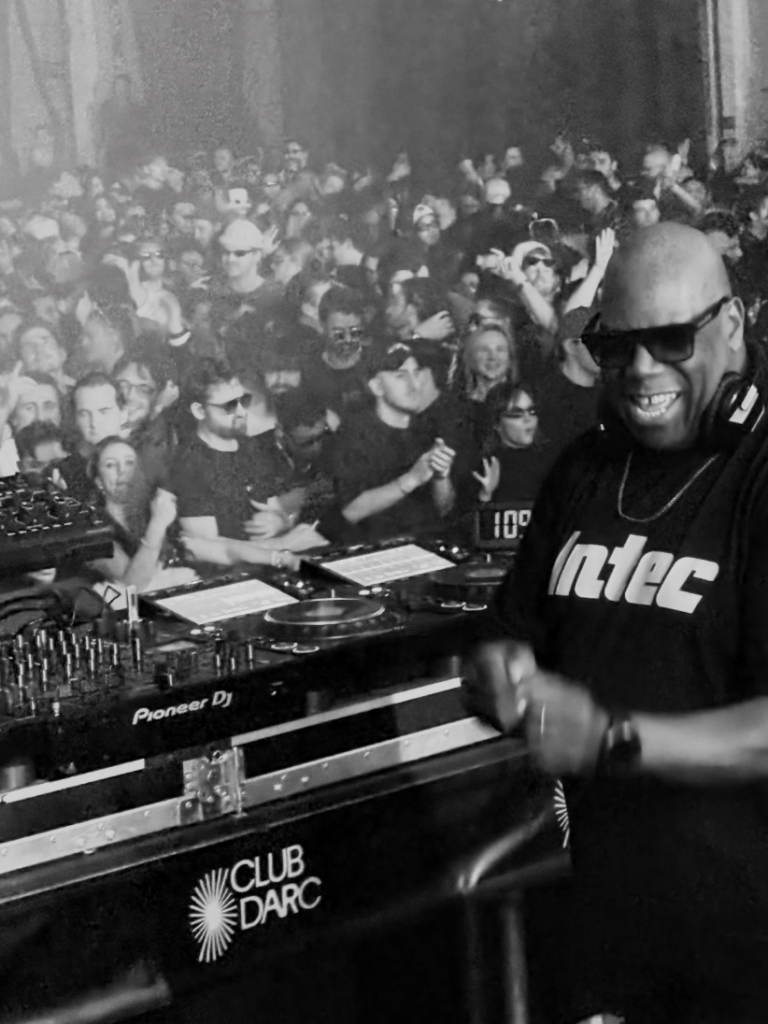
Then Carl Cox stepped up, and the entire gravity of Pier 48 shifted. Grinning ear to ear and radiating the infectious joy that has made him one of electronic music’s most beloved ambassadors, Cox didn’t just play a set; he conducted the room. Anchored behind the decks with his commanding physical presence and razor-sharp instincts, he unleashed a relentless, rolling barrage of muscular techno, tribal percussion, and subterranean acid lines that hit straight in the chest. Rather than coasting on
predictable drops, Cox built long, propulsive arcs of tension, working the EQ and faders in real time so every snare snap and bassline surge landed like a physical shockwave. The cavernous industrial surroundings became an extension of the music itself, with the hypnotic rhythms reverberating through the warehouse and transforming the concrete dance floor into a pulsating sea of bodies.
There was something particularly exhilarating about watching a DJ of Cox’s stature demonstrate the difference between simply playing great tracks and constructing an unforgettable musical journey. His transitions weren’t merely bridges between records; they were opportunities to manipulate energy, introduce new textures, and take the crowd somewhere unexpected. Layers of percussion collided with thunderous kicks, hypnotic synth patterns emerged from the depths, and moments of restraint made the eventual releases all the more explosive. Cox understands that the magic of techno isn’t necessarily found in its loudest moments but in the anticipation, the gradual buildup, and the collective release when thousands of dancers finally arrive at the same musical destination. And when that moment comes, few can deliver it with the authority of the king.
What separates Cox from nearly every other headliner on the planet is his ability to read a warehouse down to the last person in the back corner, and his fearless willingness to bridge eras on the fly. Just when the floor was locked into peak-time techno hypnosis, he pivoted effortlessly into moments of pure, hands-in-the-air euphoria, dropping timeless Detroit techno touchstones like Derrick May’s Strings of Life, released under his Rhythim Is Rhythim alias, that sent an electric roar from the front barrier all the way to the back rafters. For longtime dance music lovers, hearing that iconic record in a setting like this was a beautiful reminder of where it all began. For younger ravers, it was a lesson in why the classics still matter. Nearly four decades after its original release, the track remains a testament to the timeless power of electronic music, and in Carl Cox’s hands, it felt every bit as relevant as the contemporary techno surrounding it.
Each time he leaned into the mic with his trademark grin, the warehouse erupted right back at him, turning Shed A into a call-and-response celebration of pure dance floor release. That’s another part of the Carl Cox magic. For all his technical brilliance and legendary status, nothing about his presence feels distant or intimidating. He connects with his audience through an unmistakable sense of warmth, humor, and shared excitement. You get the feeling that if he weren’t behind the decks, he’d happily be out there dancing with everyone else.
For San Francisco, a city with a rich underground dance music history stretching back to the legendary warehouse parties and pioneering rave collectives of the early ’90s, Club Darc feels like a welcome continuation of that legacy. Goldenvoice deserves credit for creating an environment that embraces the raw spirit of underground club culture while giving world-class electronic artists a stage worthy of their talents. The phone-free approach, industrial setting, and emphasis on the collective experience are a refreshing reminder that sometimes the most powerful nights in dance music don’t require
elaborate visual spectacles or endless digital distractions. Give people a great sound system, an incredible DJ, room to dance, and the freedom to lose themselves in the moment, and you’ve already got the ingredients for something special.
By the time the final tracks echoed out across Mission Bay late into the night, one thing was unmistakable: William Kiss opened the door, and Seth Troxler lit the fuse, but November 20 belonged to Carl Cox. In a city with deep rave roots and high standards for selectors, the undisputed king of the booth walked into San Francisco’s rawest waterfront warehouse and left it completely conquered.
More than four decades into his extraordinary journey, Carl Cox isn’t simply living off his legendary status; he’s still earning it, one dance floor at a time. No gimmicks, no shortcuts, just an artist at the top of his game doing what he loves and reminding thousands of people why they fell in love with dance music in the first place.
San Francisco came to dance, Club Darc delivered the temple, and Carl Cox brought the thunder. Long live the King. Oh yes, oh yes!
For more info on Club Darc go to: www.clubdarc.com